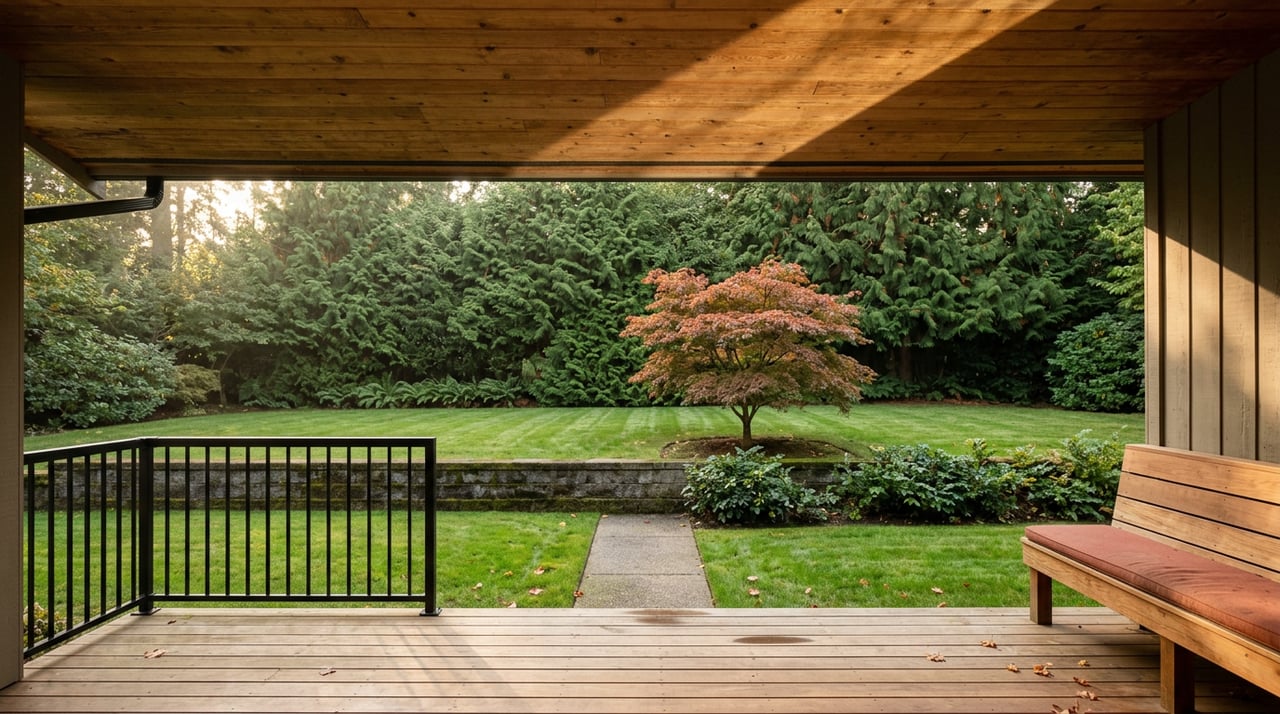
Two listings land on a buyer's desk the same week. Both are inland, both a few blocks from Oswego Lake, both priced within a few thousand dollars of each other. Near the bottom of each sheet sits the same phrase: "Lake easement rights included." No dollar figure. No explanation of what the phrase is actually worth. A buyer who has read the news over the past two years might assume it barely matters anymore, since a judge ruled the lake is public now. That assumption is the expensive one.
The truth sitting underneath both listings is that "lake easement rights" can mean a boat slip you can use this season, or a spot on a waitlist that hasn't moved in years. The words on the page are identical. What they buy is not. And the court case that made headlines across Portland television stations for the better part of a decade has almost nothing to do with which listing gets you on the water.
Lake Oswego's namesake lake has been managed since 1942 by the Lake Oswego Corporation, a private entity owned collectively by lakeside and easement-eligible homeowners. For over a decade, the city backed an ordinance that blocked the general public from entering the lake through any city-owned park. Two Portland-area residents, Todd Prager and Mark Kramer, sued in 2012 arguing the lake was a navigable public waterway under the Oregon Constitution and that the city's restriction was unlawful.
The case took twelve years to resolve. In November 2024, Clackamas County Circuit Court Judge Kathie Steele ruled the city's blanket ban was illegal and ordered Lake Oswego to open one specific entry point, the concrete steps at Lower Millennium Plaza Park, while upholding the city's restrictions at two other potential access sites, Sundeleaf Plaza and Headlee Walkway. In April 2025, the Lake Oswego City Council voted 5 to 2 not to appeal.
That is the version of the story most people know. The version that matters to a buyer looking at a listing is narrower. The court-ordered access point allows swimmers and non-motorized watercraft under 18 feet, during daylight hours, at a single staircase downtown. Motorized boats, jet skis, and trolling motors still are not permitted there. According to Lake Oswego Review's reporting from August 2026, the Lake Oswego Corporation itself did not accept the ruling and is still pursuing its own appeal at the Oregon Court of Appeals, arguing the portion of the lake in question was artificially expanded in the 1920s and was never navigable at statehood. That appeal was still active as of this writing.
The city, meanwhile, has been running the new access point for two full seasons. By the second summer in 2026, it had scaled back the staffing that came with the first year: no dedicated park ranger monitoring the steps, and no planned closure over the Fourth of July weekend, a decision that had drawn criticism the year before. The rules have held, but the infrastructure around them is still being adjusted year to year, which is not the language of a settled question.
None of this changed the private lake economy that most Lake Oswego buyers are actually navigating. Access for anyone other than that one public entry point still runs through the Lake Oswego Corporation's system of 20 individual easements, a structure that traces back to real property instruments originally granted by the Oregon Iron and Steel Company. More than 3,000 homes in the city carry deeded eligibility for one or more of these easements, a category separate from the roughly 700 properties that sit directly on the shoreline as lake corporation shareholders.
The eligibility itself is fixed to the deed. It cannot be bought, sold, or transferred independent of the property, and a home that was never granted access cannot have it added later no matter what a buyer is willing to pay. That single fact rules out the workaround a lot of relocating buyers assume exists.
What the deed does not fix is the experience once you join. Each of the 20 easements is run by its own volunteer board with its own bylaws, its own fee schedule, and its own physical capacity, and the Lake Oswego Corporation's own site is explicit that facilities and rate structures vary from one easement to the next. Members also pay a second, separate fee directly to the Lake Corporation on top of whatever their individual easement charges, a corporation-wide assessment that funds water quality monitoring, dam maintenance, and safety patrol, and that has trended upward in recent years.
Here is where the real variance lives, and it has nothing to do with the court case:
| Easement | Annual Dues | Capacity Signal |
|---|---|---|
| Blue Heron | Around $200 | 24 boat slips available |
| Goodin | Similar to Blue Heron | Powerboat waitlist of 44, rack waitlist of 73 |
Both charge roughly the same amount. One gets a member on the water within the season. The other adds a name to a line that, based on historical turnover, may not move for years. A listing that simply says "lake easement rights" gives no indication of which of these two situations a buyer is stepping into, and agents don't always volunteer the distinction unless asked directly.
Pull a market snapshot for Lake Oswego and the number moves depending on the window. Across all of 2025, 489 closed single-family sales in the city put the median at $1.1 million. A narrower, more current three-month window ending in May 2026 showed a median of $969,000, up close to 4 percent year over year, with homes averaging 22 days on market. Neither figure tells a buyer anything about whether the home behind it carried usable lake access.
That blend is the actual gap in the data. The city's median mixes homes with no lake connection at all, homes tied to an easement with open capacity, and homes tied to an easement with a multi-year waitlist, all under the same three words on the listing sheet. Roughly 30 percent of Lake Oswego sales close above $1.5 million, a price band where lake proximity is doing real, measurable work on value, but that segment includes both true waterfront homes with private docks and inland homes whose only lake connection is a deeded right that may or may not come with anywhere to put a boat.
Treating "lake access" as a single variable the market has already priced in is how a buyer ends up either overpaying for a right they can't use this decade, or walking away from a well-positioned easement because the listing made it sound the same as every other one on the block.
A buyer can close this information gap in a handful of phone calls, and it is worth doing before falling for a specific house rather than after.
None of this shows up in a portal search filter. It shows up in a conversation with the right person before the inspection period closes.
Does every home in Lake Oswego have some form of lake access? No. More than 3,000 homes carry deeded eligibility for one of the 20 private easements, but that leaves a meaningful share of the city's housing stock with no lake connection beyond the single public entry point at Millennium Plaza Park.
Can I add lake easement rights to a home that doesn't already have them? No. These rights are tied to specific deeds established through historical property instruments. A home either carries eligibility or it doesn't, and that eligibility cannot be purchased separately or transferred from another property.
Did the public access ruling reduce what a private easement is worth? Not based on what actually changed. The ruling opened one entry point for swimmers and small non-motorized craft at specific hours. The Lake Corporation's docks, slips, and easement system continue to operate exactly as before, and the corporation is still contesting the ruling on appeal as of August 2026.
Lake access in this city has always been a matter of which door you're standing at, not just whether you're standing near the water. If you're comparing listings that both mention easement rights, or you own a lake-adjacent home and want to understand how your specific easement affects what buyers will pay, Green Buck Real Estate can walk through the address-level details with you before you're the one holding a listing sheet that doesn't say enough.
Address 4200 Mercantile Dr #700 Lake Oswego, OR 97035
Address 4200 Mercantile Dr #700 Lake Oswego, OR 97035